SolarDT
Development of an Artificial Intelligence Enabled Digital Twin of a Solar Photovoltaic Plant to Enhance Renewable Penetration in Power Grid of Bangladesh

Electrical Engineering Graduate | Research Assistant
Prospective MS/PhD ApplicantResearch interests: Machine Learning, Digital Twin, Power Systems, Smart Grid, Renewable Energy and Power Electronics.
Md. Sabbir Hossain Molla holds a BSc in Electrical, Electronic and Communication Engineering (EECE) from the Military Institute of Science and Technology (MIST). He is a Research Assistant at the Smart Grid & Sustainable Energy Transition Lab (SET Lab), Department of EECE, MIST. His current work focuses on an AI-enabled digital twin for solar photovoltaic (PV) systems.
He has also worked on machine learning-based electricity theft detection, smart grid security, and large-scale electricity consumption analysis. He has published four papers at IEEE conferences, and two more papers on solar PV forecasting have been accepted at IEEE SUSTAIN 2026. At SET Lab, he mentors three Undergraduate Research Assistants (URAs). He guides them in literature review, research planning, and technical implementation. He also leads the team on the project “Adaptive Event-Driven Sampling for Low-Cost Smart Grid Monitoring Using ESP32.”
His research interests include intelligent power and energy systems, renewable energy integration, and digital twins. He would like to extend this work to power electronics for renewable integration. He plans to pursue an MS and then a PhD in electrical engineering. His goal is to develop advanced methods for reliable, efficient, and sustainable power systems.
Development of an Artificial Intelligence Enabled Digital Twin of a Solar Photovoltaic Plant to Enhance Renewable Penetration in Power Grid of Bangladesh

Generalising Violence Detection with a New Near-Real-World Violence Dataset

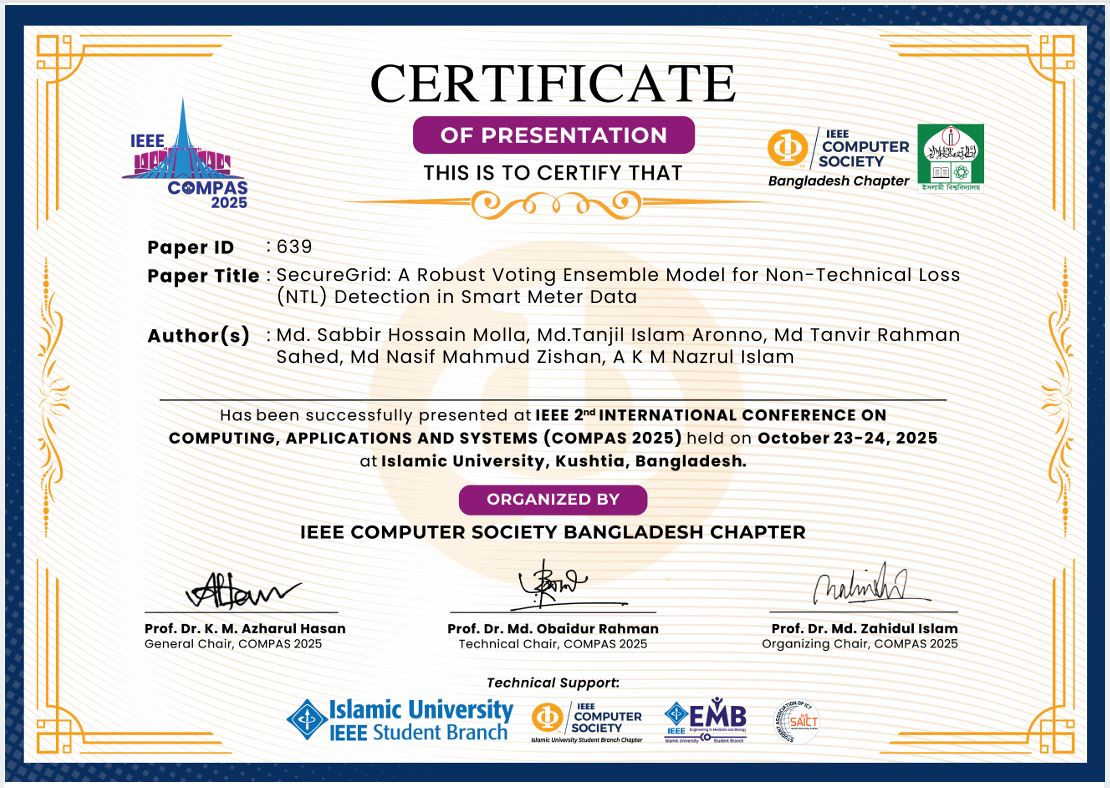
SecureGrid: A Robust Voting Ensemble Model for Non-Technical Loss (NTL) Detection in Smart Meter Data